
Ben Dhiman won the 2026 UTMB in 18 hours, 16 minutes and 29 seconds — the fastest winning time ever recorded at the race and the first finish inside 19 hours. UTMB lists the 2026 course at 174 km with 9,700 m of climbing. The start was delayed two hours for storms and organisers removed the Pyramides Calcaires section, so the time should not be read like a road-race course record.
The more useful comparison is with himself. Dhiman finished second at UTMB in 2025 in 19:51:37, on a 174.2 km course with 9,920 m of climbing. That edition was also modified by weather and also bypassed Pyramides Calcaires. The two races were not identical, but the biggest route omission was shared. Dhiman was still 1 hour 35 minutes faster in 2026.
He was not the only one moving quickly. Baptiste Chassagne finished second in 18:47:38, Caleb Olson third in 18:48:24 just 46 seconds later, and Virgile Moriset fourth in 19:00:23. Three men broke 19 hours on the same day and a fourth missed it by 23 seconds. Something about this edition was fast, though the results alone don’t explain why.
But the number that impresses me most is not 18:16.
It is 31:09 — Dhiman’s winning margin. He moved to the front around La Balme, 41 km in, with Chassagne still only about 45 seconds back at the Croix du Bonhomme, then made the decisive break on the descent toward Les Chapieux and never gave the lead up.
The advantage was not perfectly linear, and that makes the race more interesting. Chassagne reduced the gap from 28:12 at Champex-Lac to 25:53 at Trient. Dhiman then opened it again, reaching Vallorcine 30:47 clear. He did not disappear early and cruise home. He built a large lead, saw part of it come back, and extended it again late.
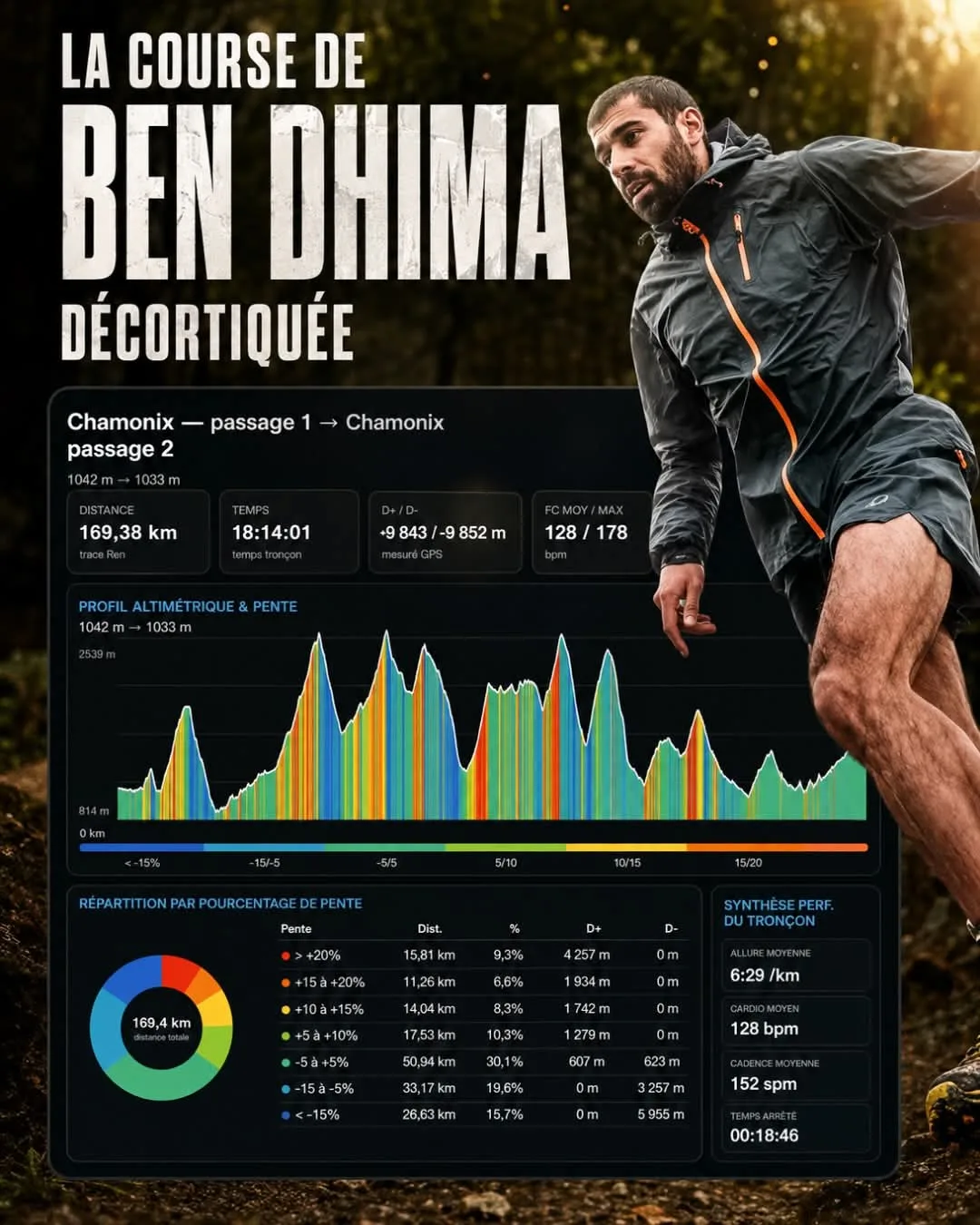
There is also a recorded GPS analysis of his race, broken into 19 segments: 169.38 km, +9,843 m, 18:14:01, average cadence 152 spm. It isn’t an official measurement (the caveats, which matter, are gathered near the end of this piece), but for comparing one part of his race against another, it’s genuinely useful.
One limit matters before anything else, because it shapes everything that follows. The trace shows how Dhiman produced his performance. The official checkpoint splits show where he separated from the field. What no public dataset gives us is equivalent terrain-by-terrain movement data for Chassagne or Olson. So when the trace says he climbed a section at 822 vertical metres an hour, we cannot say that climb won him the race. We do not have the denominator.
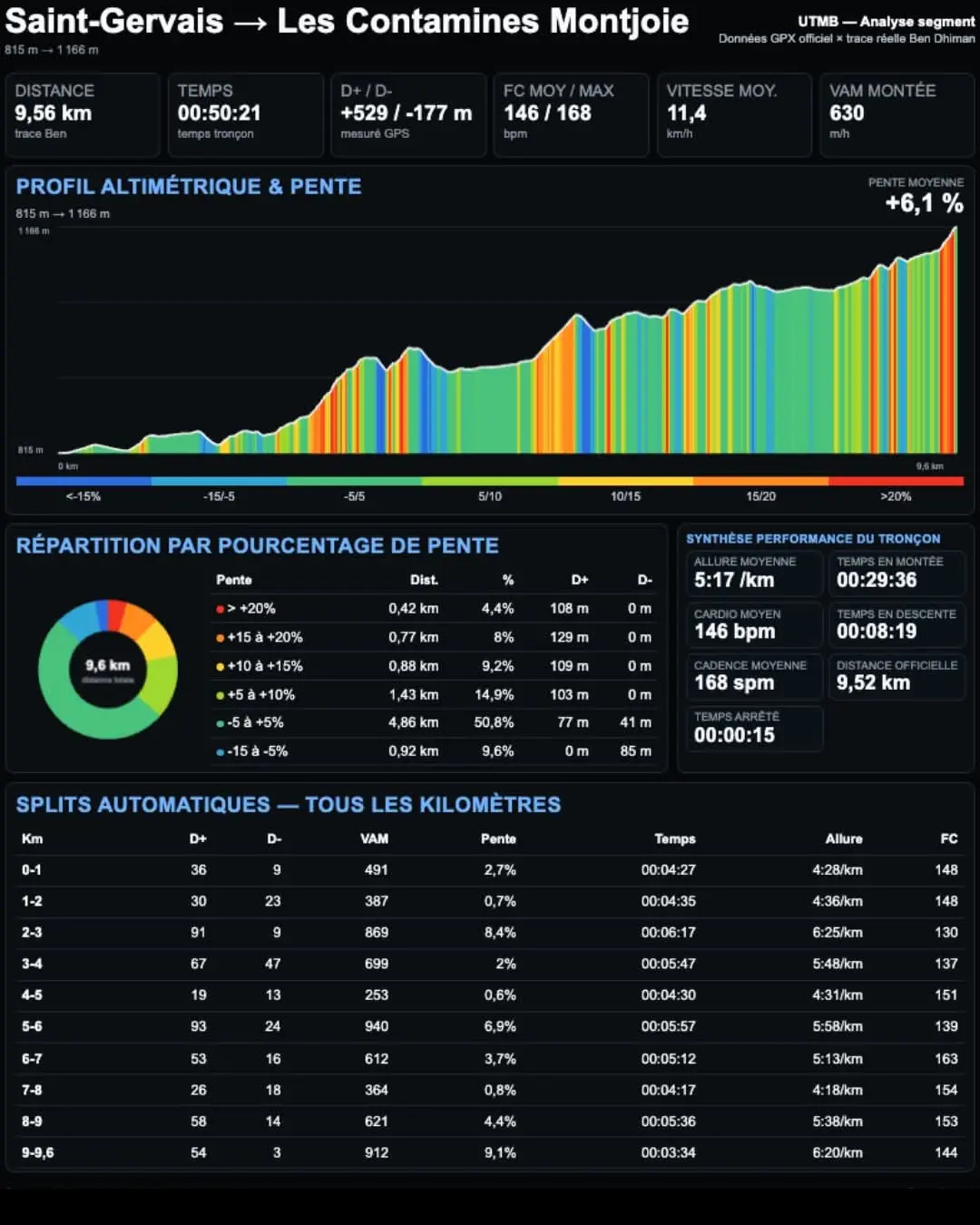
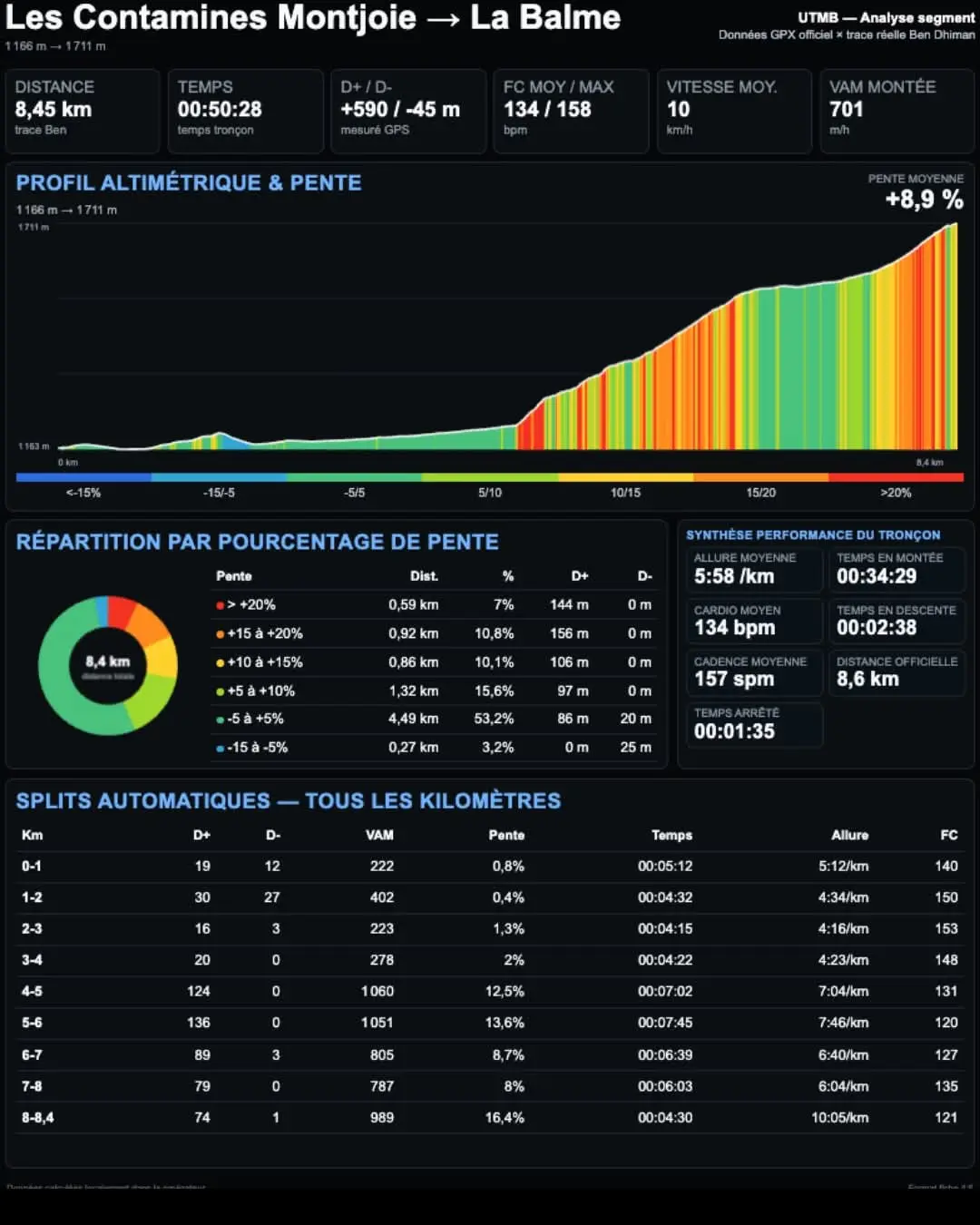
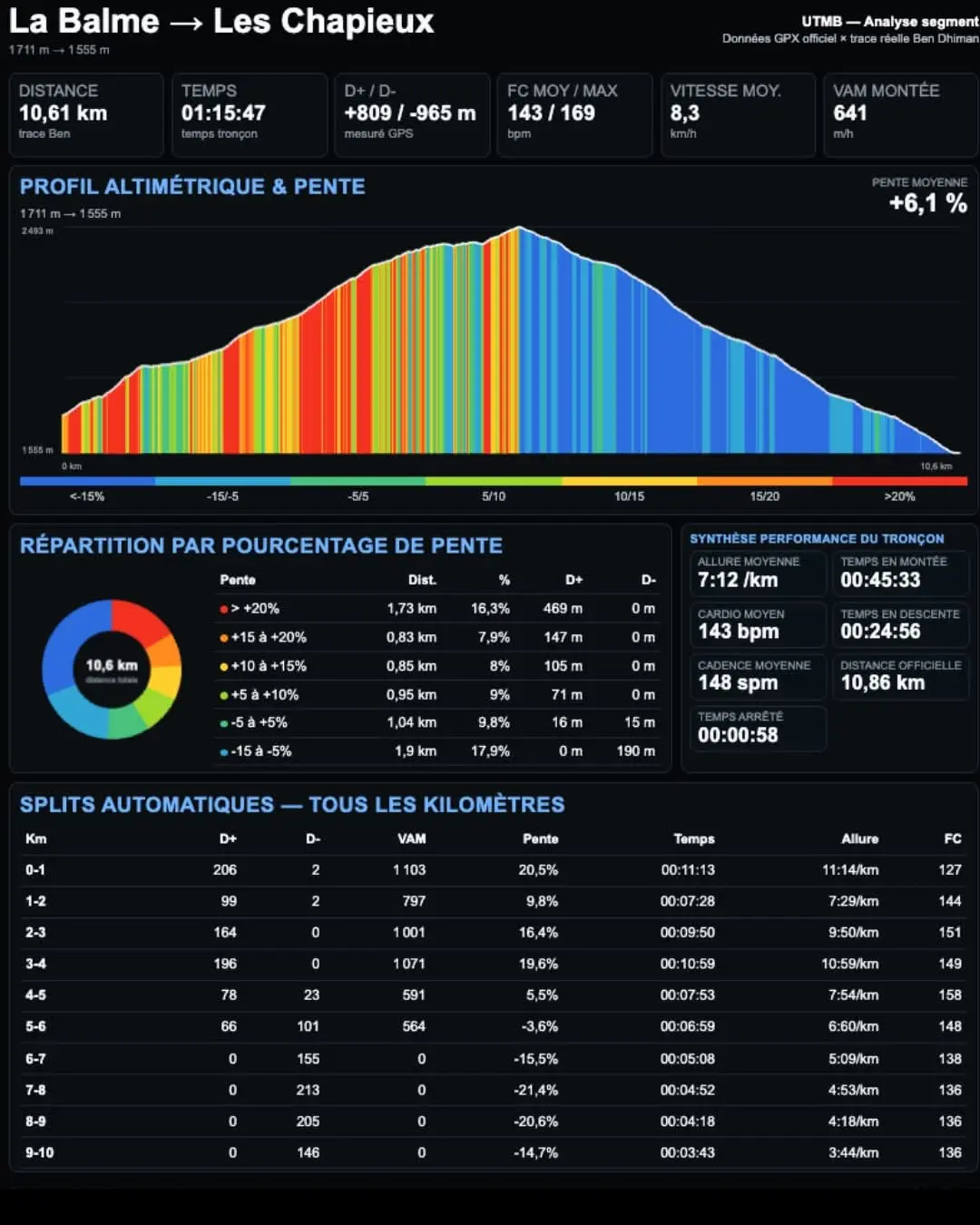
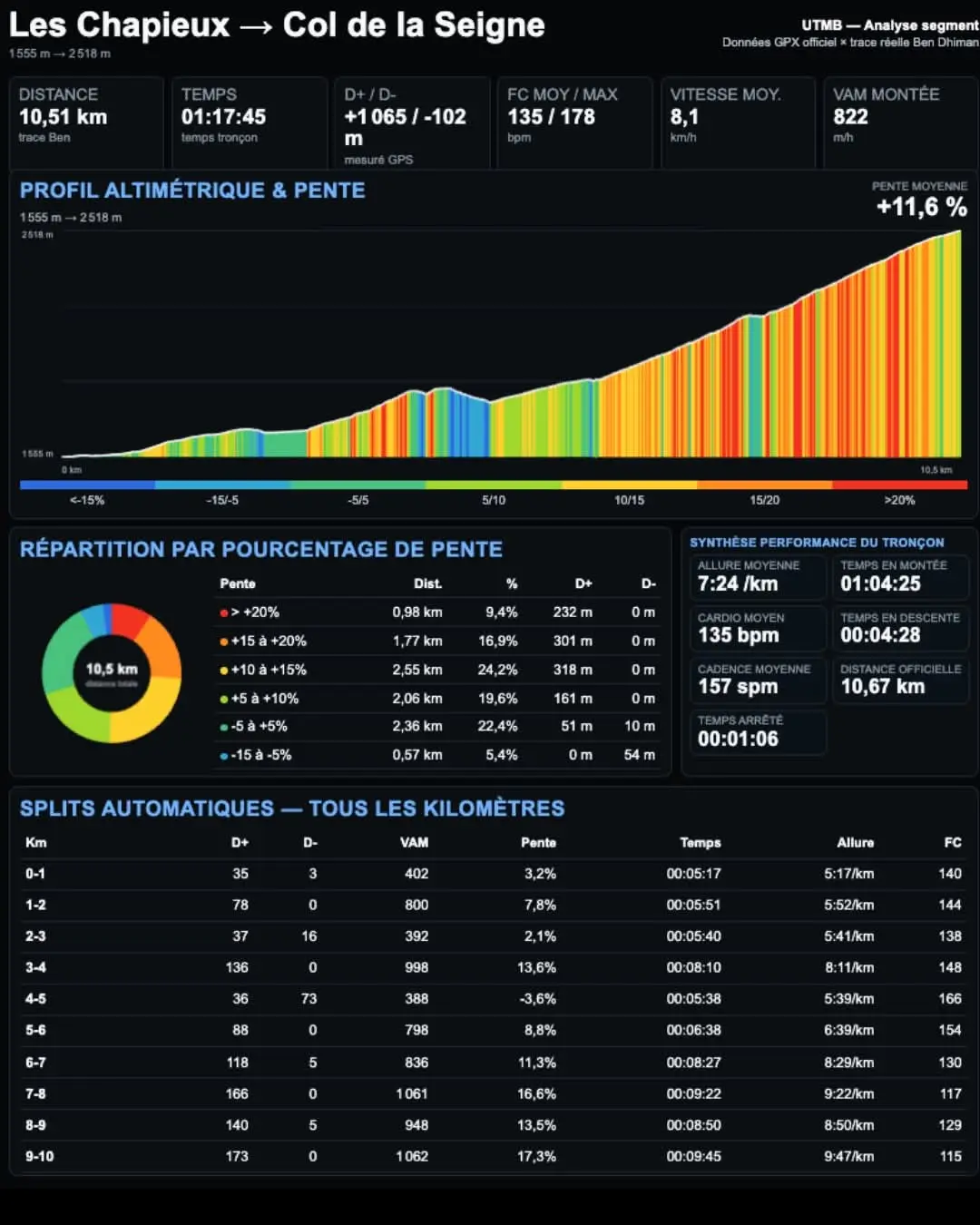
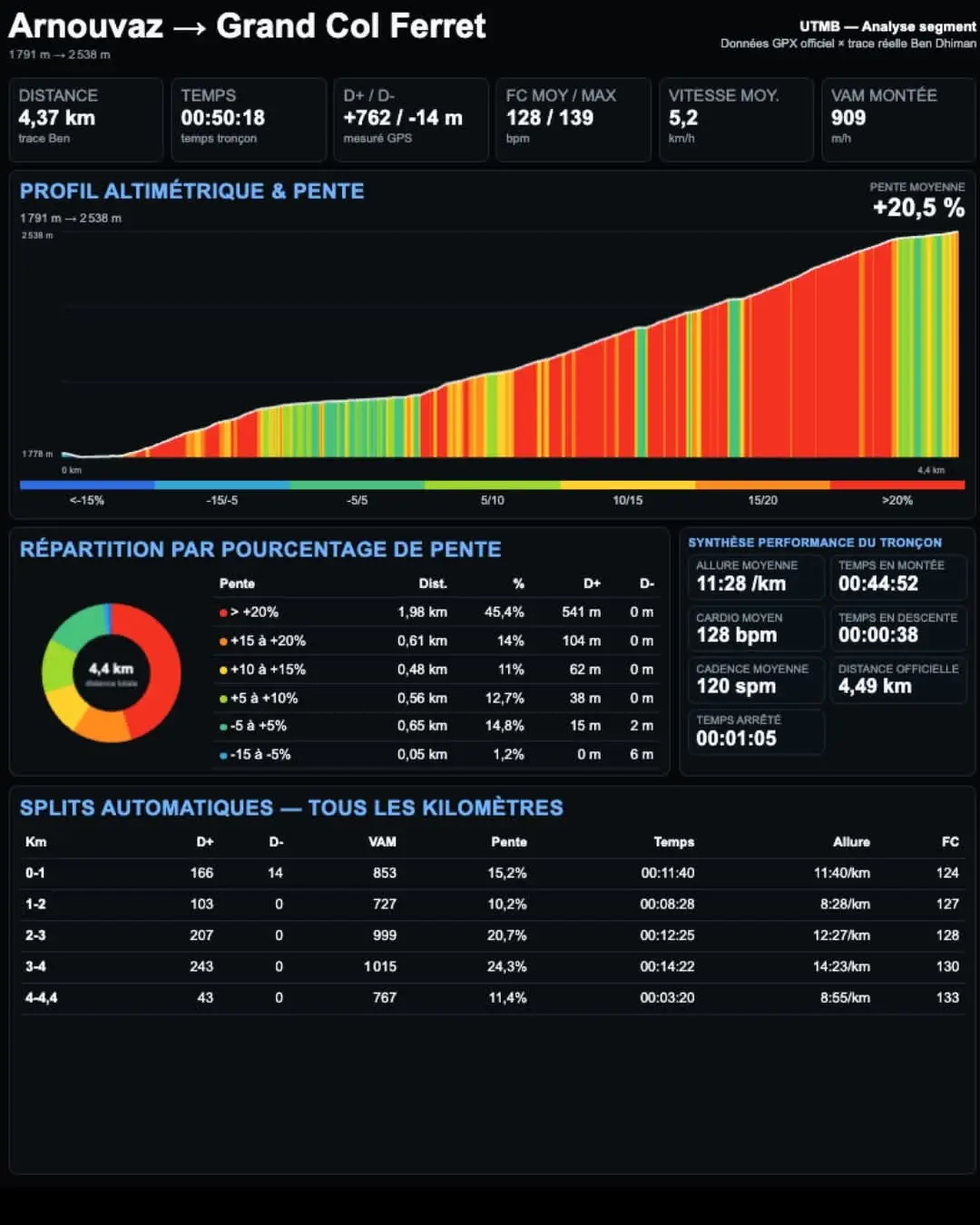
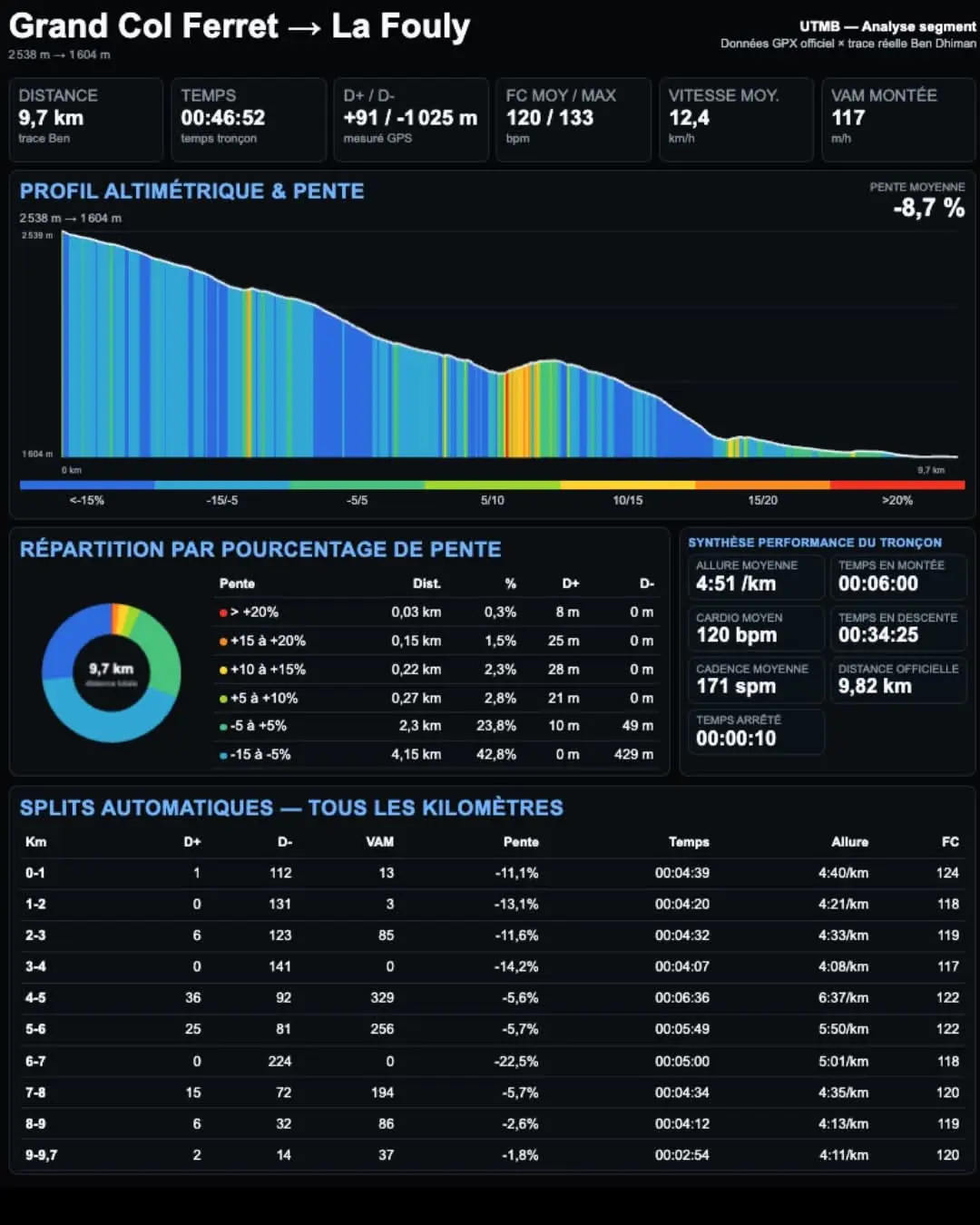
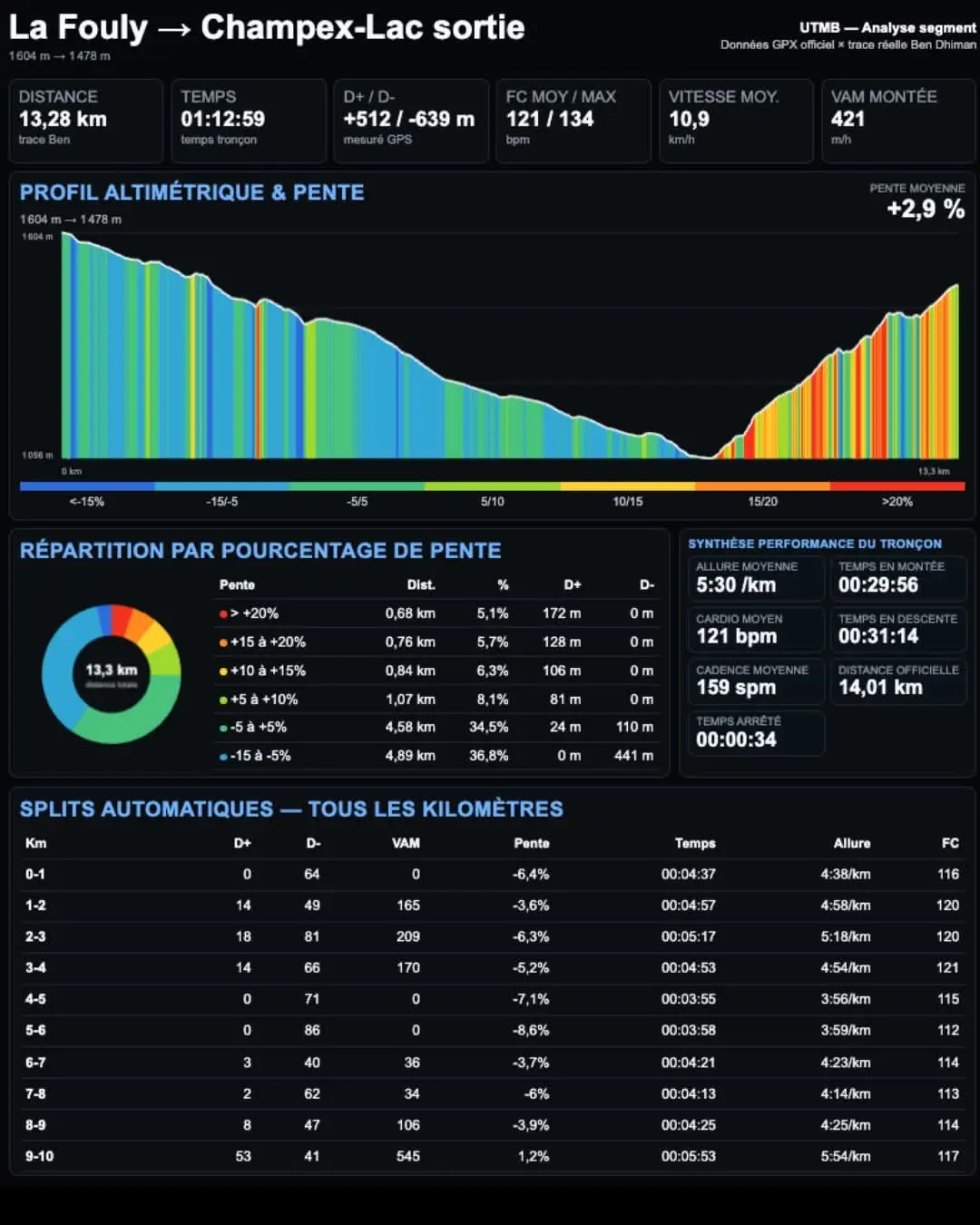
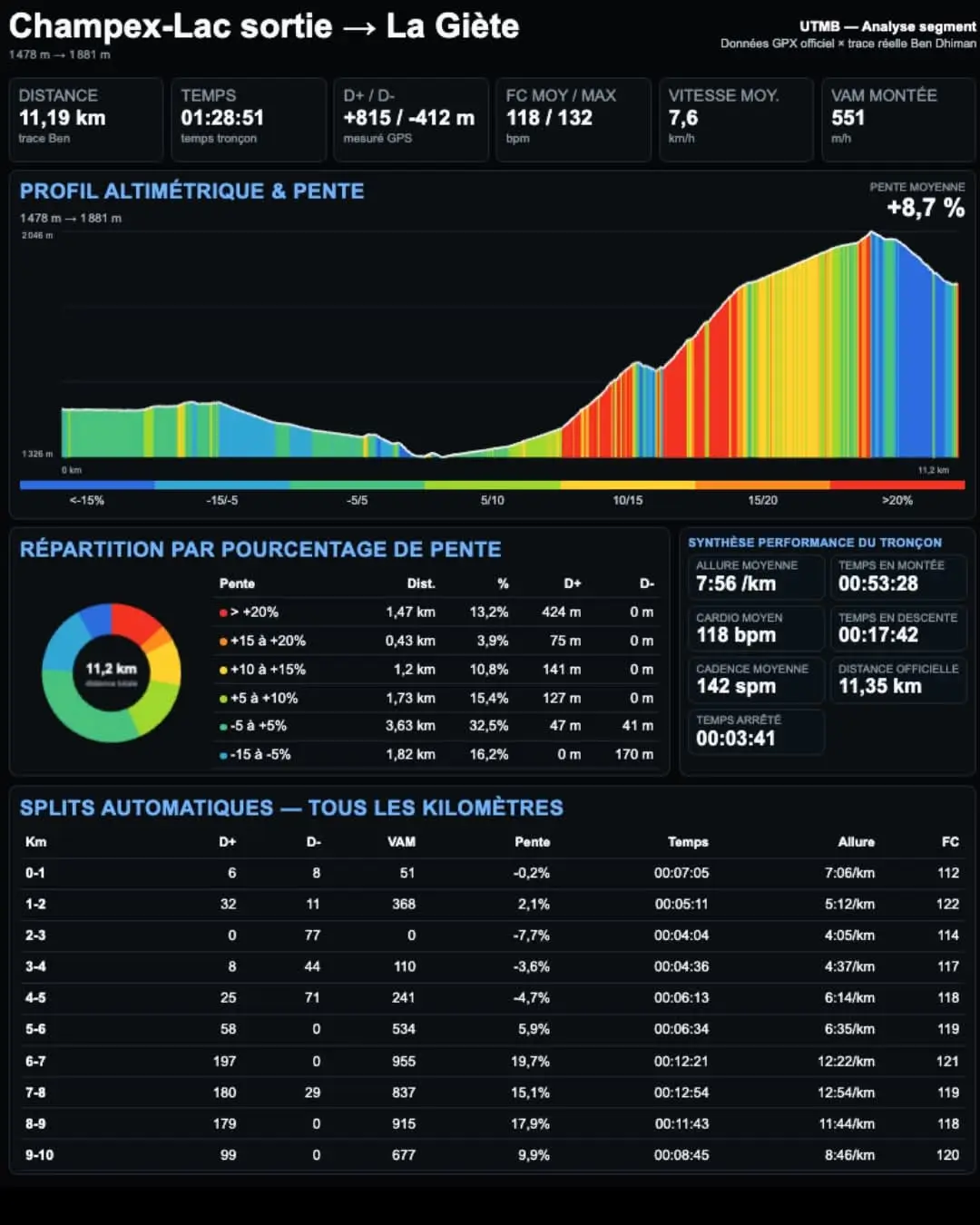
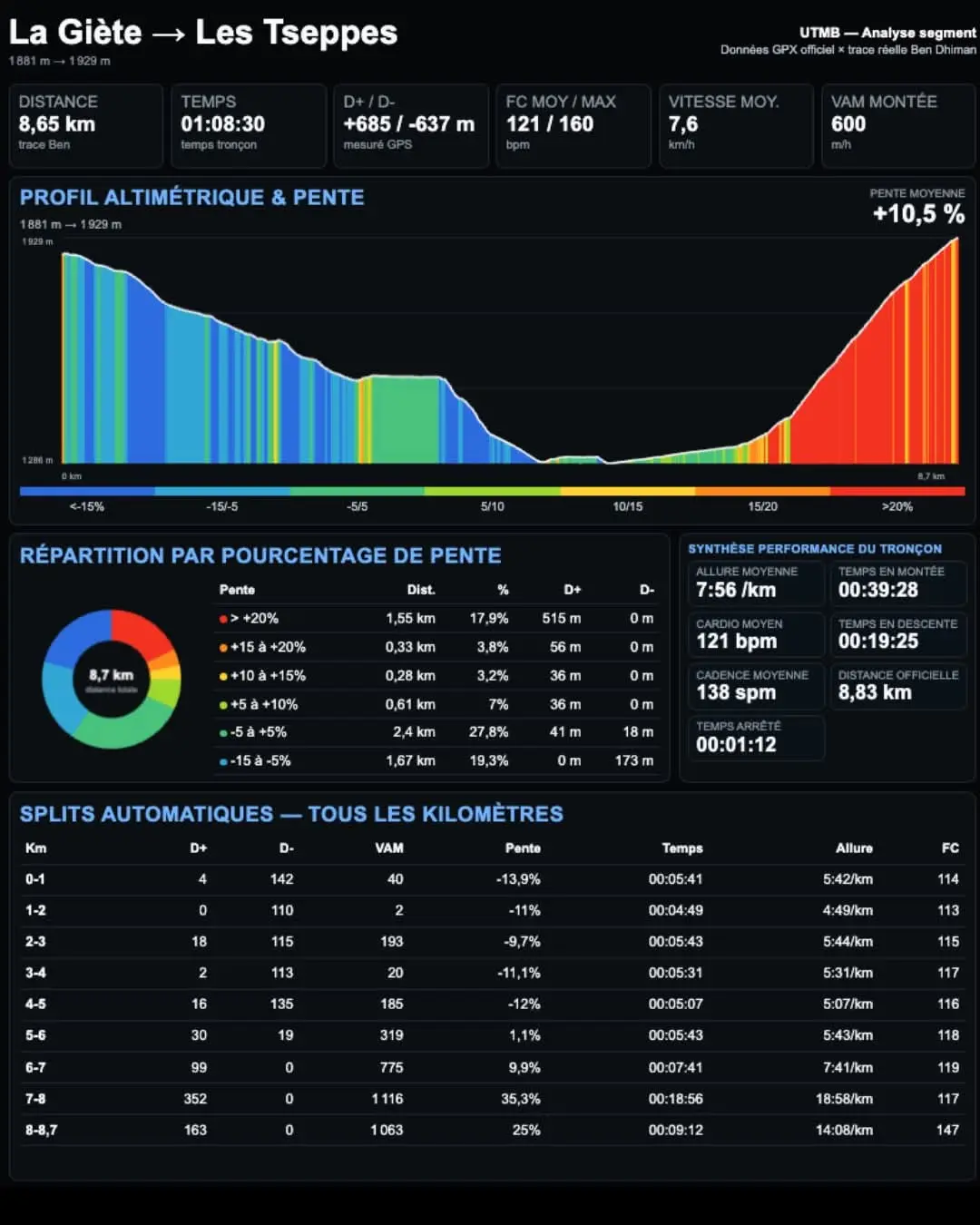
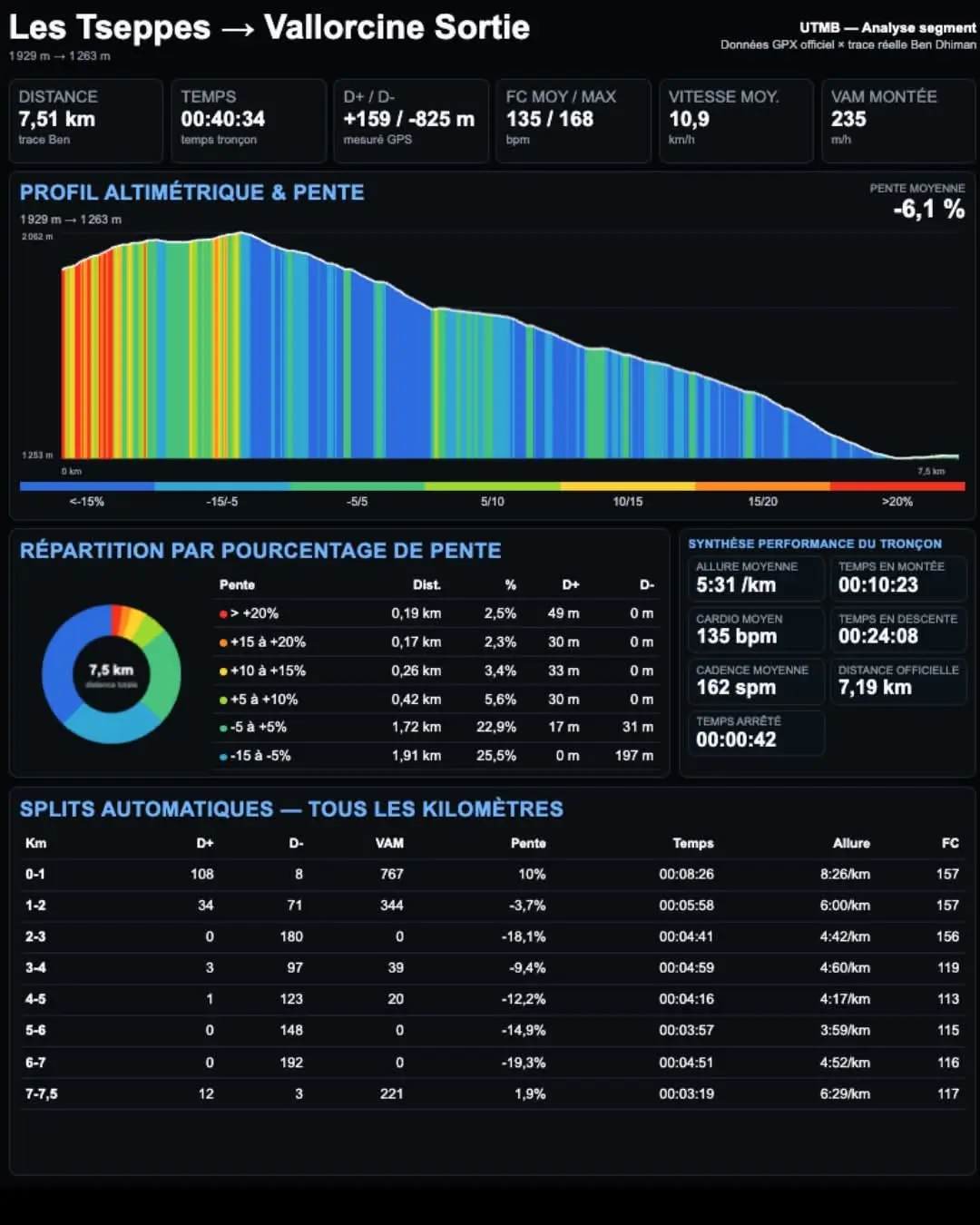
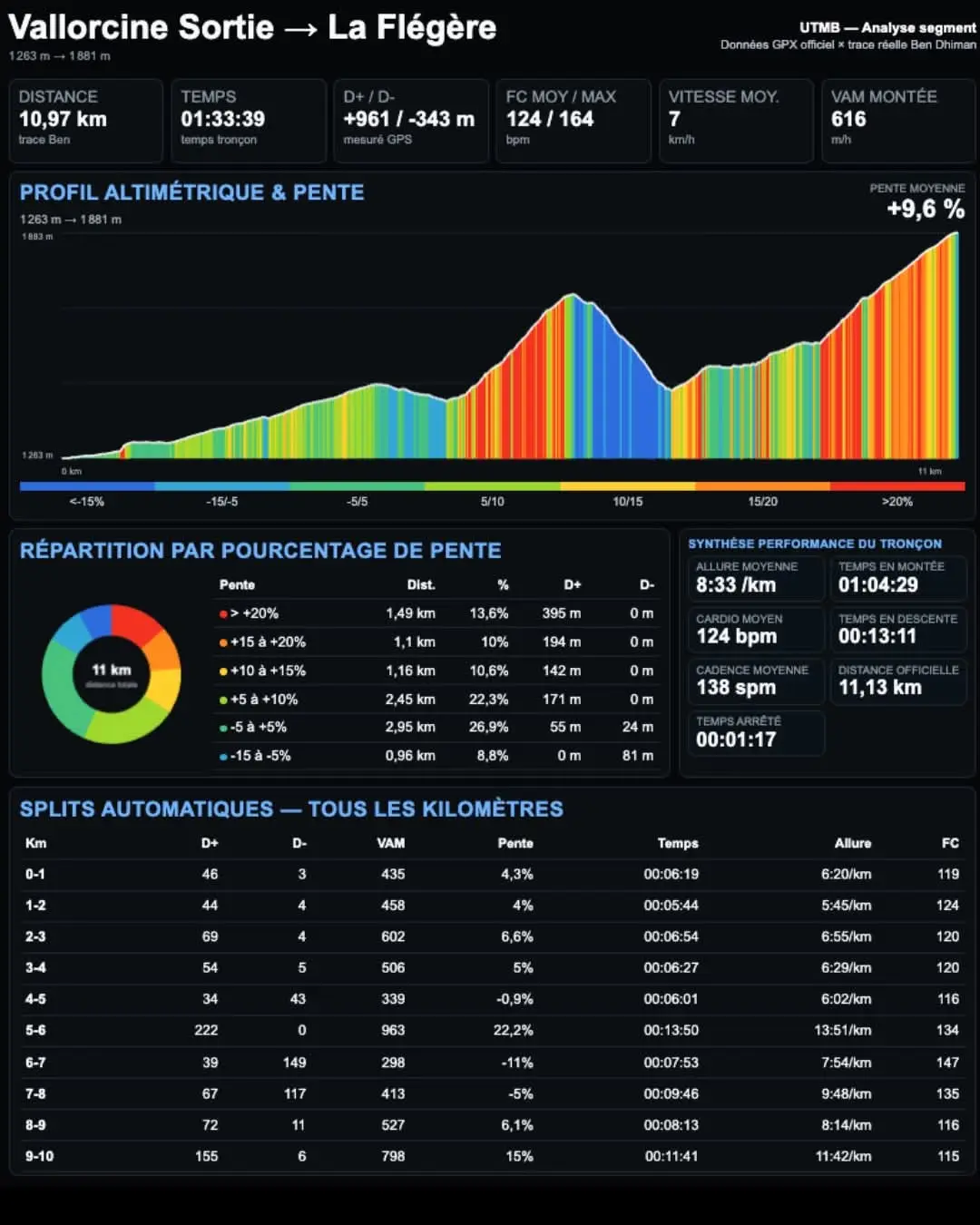
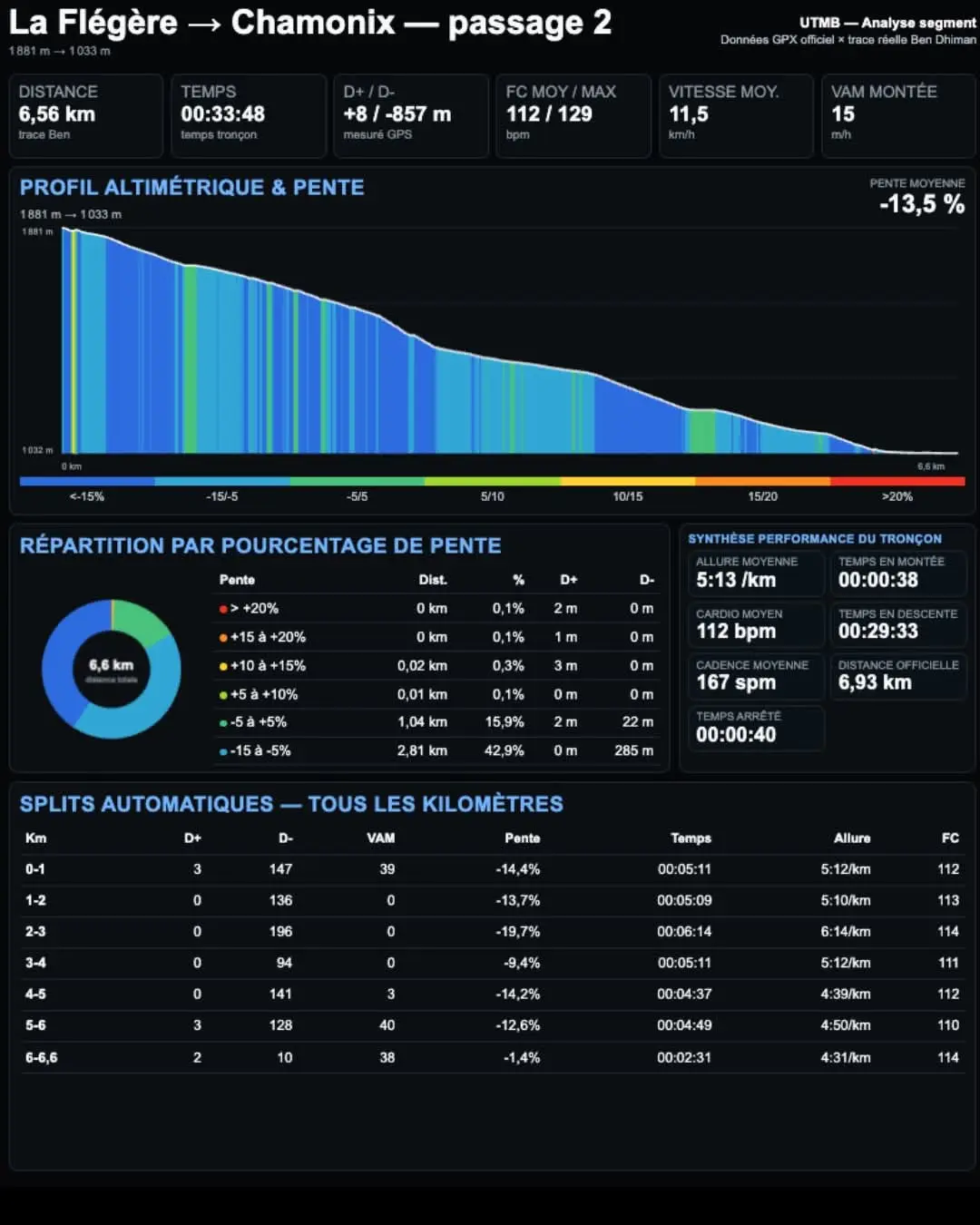
One race, many different jobs
The platform reports an average pace of 6:29/km, and that number tells us remarkably little.
Across the 19 segments, Dhiman moved from 4:17/km on runnable ground to 11:28/km on the steepest climbing.
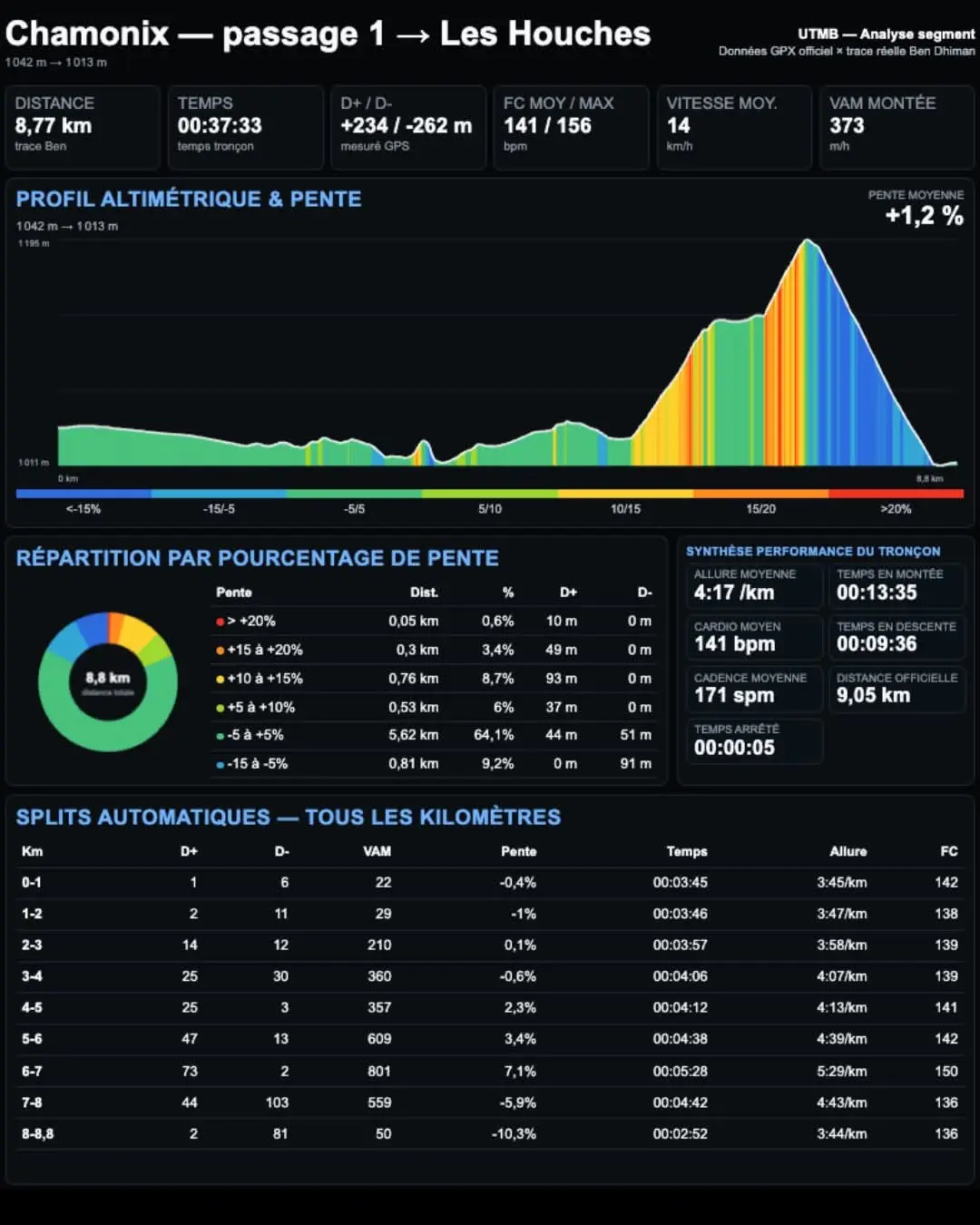
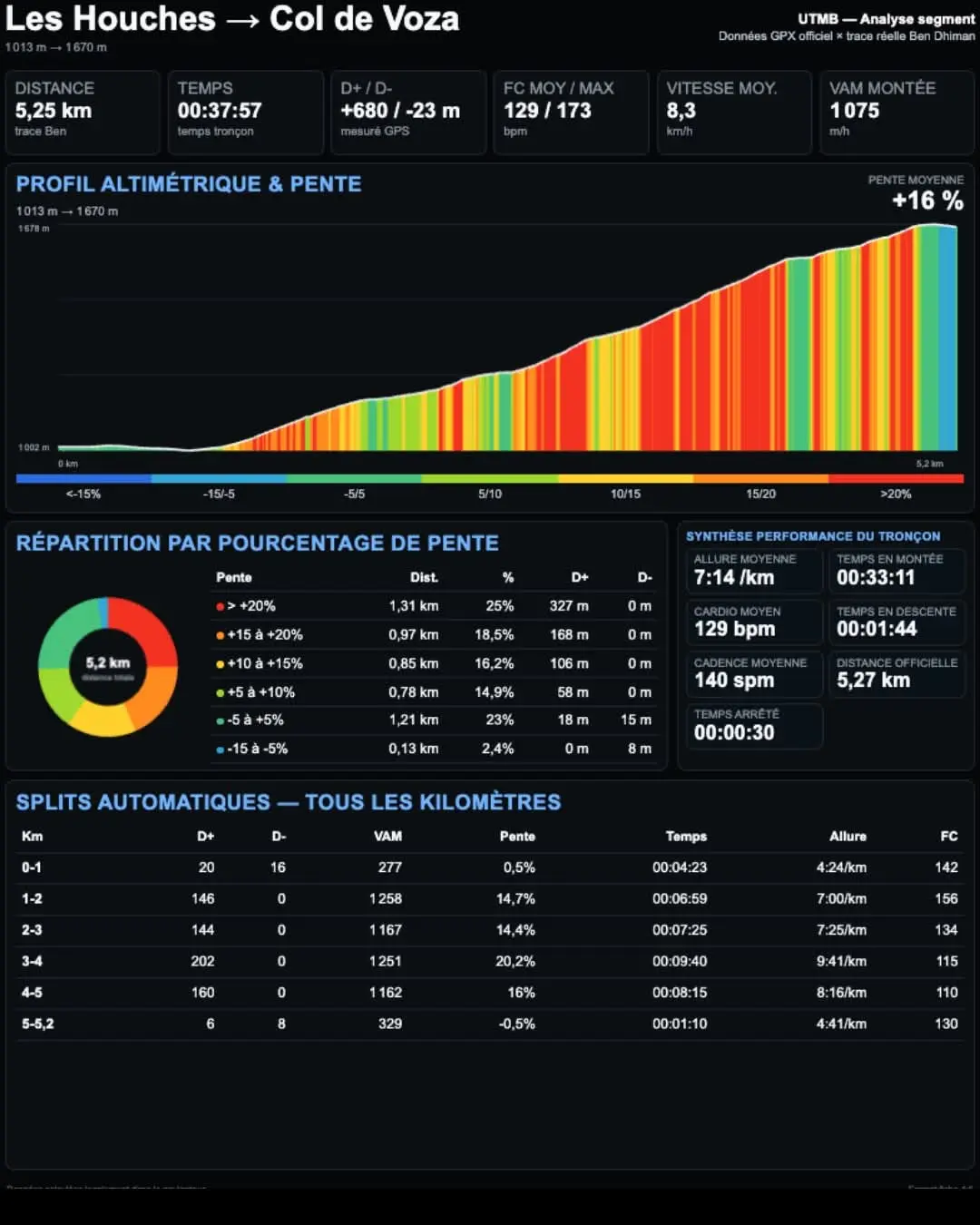
The opening 8.77 km from Chamonix to Les Houches took 37:33 — 4:17/km, despite containing 234 m of climbing and 262 m of descent. Then the job changed. From Les Houches to Col de Voza he covered 5.25 km with 680 m of ascent in 37:57. Pace fell to 7:14/km, cadence from 171 to 140 steps per minute, and the segment produced a vertical gain rate of about 1,075 m/h.
Nothing had gone wrong. The terrain required a different form of locomotion.
A 4:20 kilometre on runnable trail and a 12-minute kilometre up a steep Alpine climb are both recorded as one kilometre. Mechanically, they are different jobs.
The full-race gradient classification makes the point at scale:
| Gradient | Distance | Share |
|---|---|---|
| Above 20% up | 15.81 km | 9.3% |
| 15–20% up | 11.26 km | 6.6% |
| 10–15% up | 14.04 km | 8.3% |
| 5–10% up | 17.53 km | 10.3% |
| −5% to +5% | 50.94 km | 30.1% |
| 5–15% down | 33.17 km | 19.6% |
| Steeper than 15% down | 26.63 km | 15.7% |
Only 30% of the recorded distance was anything close to flat. About a quarter was uphill at 10% or steeper, more than a third downhill steeper than 5%. And 4,257 m of ascent — some 43% of all the climbing in the trace — came on ground above 20%.
Look at the numbers: climbing and steep descent accounted for most of the course. Running, in the flat sense most people picture, was the exception here, not the rule.
The biggest climb
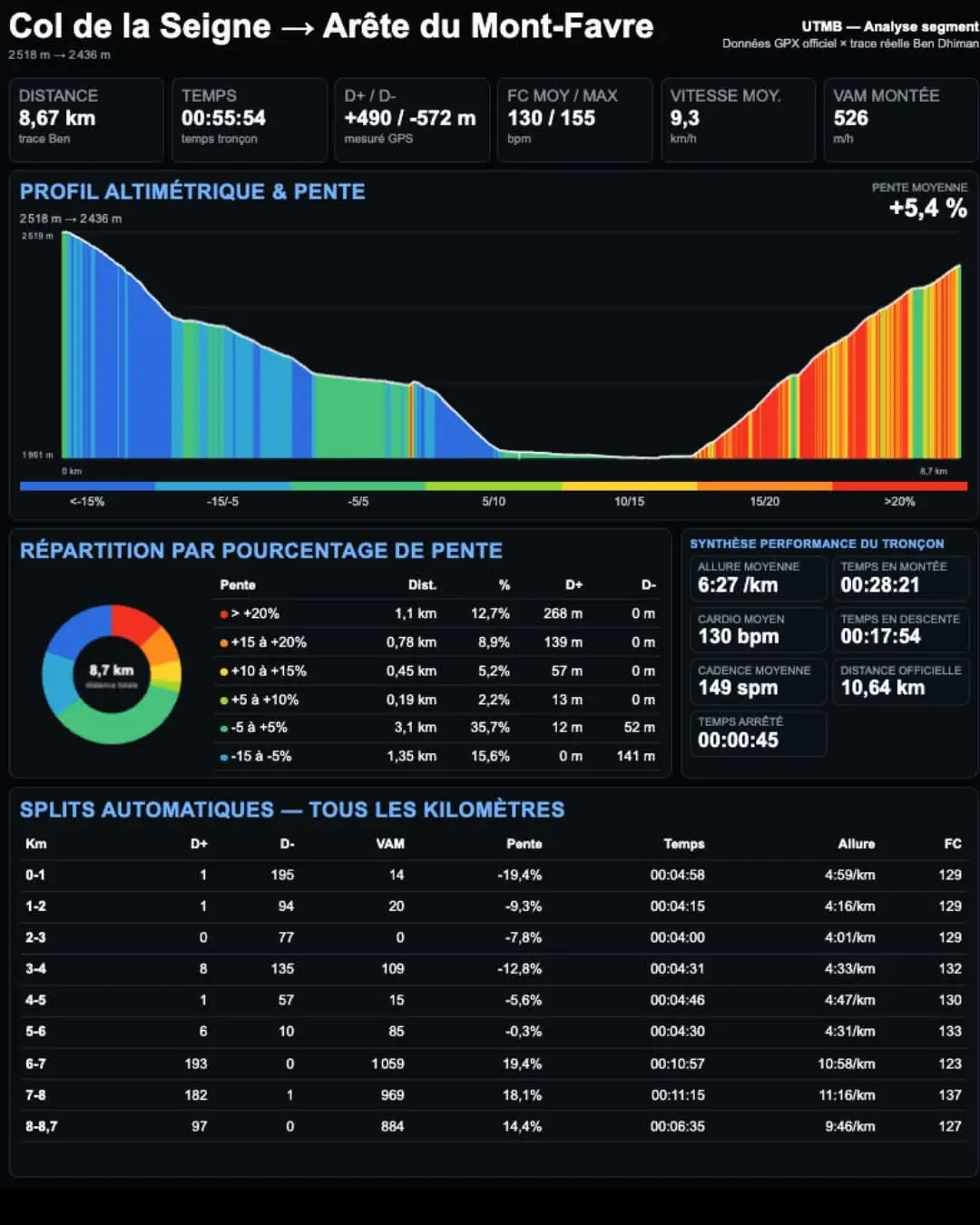
The largest single ascent came from Les Chapieux to Col de la Seigne: 10.51 km, +1,065 m, 1:17:45, at 822 vertical metres an hour.
Duration matters when comparing VAM. A vertical rate held for 20 minutes and the same rate held for 80 minutes are different performances. Dhiman gained more than a vertical kilometre on the Seigne section while averaging 822 m/h across 1:17:45.
What makes 822 interesting is less the number itself and more how much climbing it covers, and how long he sustained it.
The steep climbs
Two later sections stand out for gradient rather than size.
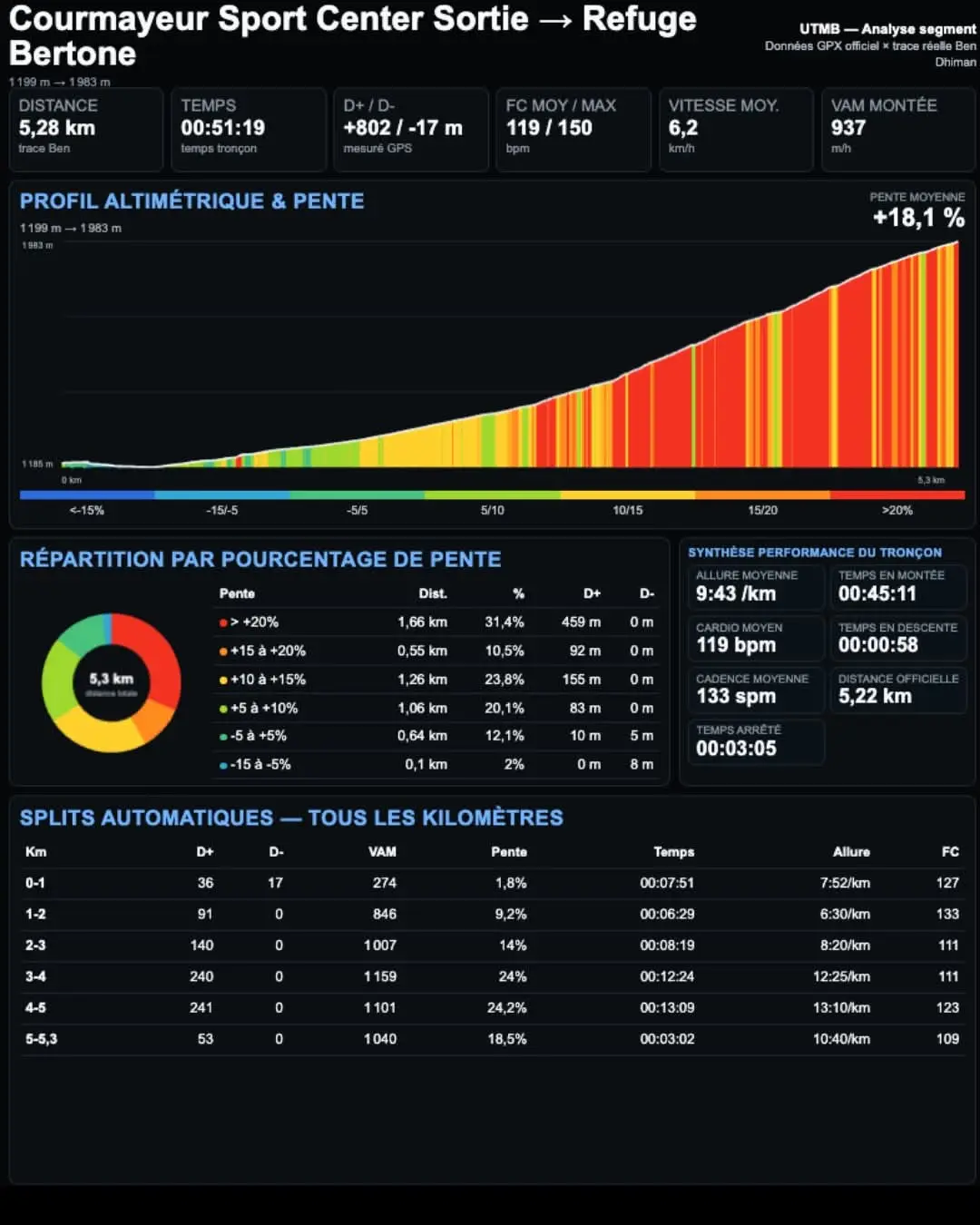
Courmayeur to Refuge Bertone — 5.28 km, +802 m, 51:19, 937 m/h, with around 31% of the segment classified above 20%.
Arnouvaz to Grand Col Ferret — 4.37 km, +762 m, 50:18, 909 m/h, roughly 45% above 20%, and individual kilometres at 20.7% and 24.3%.
On this ground, speed stops being the useful measure. What matters now is running versus power hiking.
His cadence on Grand Col Ferret averaged 120 spm, the lowest of the 19 segments. On the descent immediately after — 9.7 km and 1,025 m down to La Fouly — it returned to 171.
Cadence does not tell us how hard either effort was, or whether economy and force production had deteriorated underneath. But the abrupt change is useful descriptively: he had not become trapped in one slow movement pattern. The terrain changed and so did he.
That switching is more interesting than the cadence itself. Strong mountain runners can climb quickly. Ultra performance asks the harder question — can you climb hard, descend afterwards without destroying the legs, and then run again when the trail allows it?
By Grand Col Ferret his lead was already around 22 minutes.
The climb that matters more
The most impressive number may be one of the smaller ones.
Late in the race came Vallorcine to La Flégère: 10.97 km, +961 m, 1:33:39. Dividing ascent by total segment time gives 616 m/h — a whole-segment descriptor, not his climbing speed, since the section includes flatter and descending ground.
Beside the earlier 800s and 900s, 616 looks ordinary. But look at when it happened. Dhiman had covered more than 150 km and raced through the night, and around 10 km from the finish, partway up this climb, he tripped on a rock and fell hard. He got up, completed the ascent to La Flégère, and carried on toward Chamonix.
616 m/h on its own looks unremarkable. What makes it worth noting is where in the race it happened.
The descents
Climbing consumes the engine. Hard descending is often what destroys the legs.
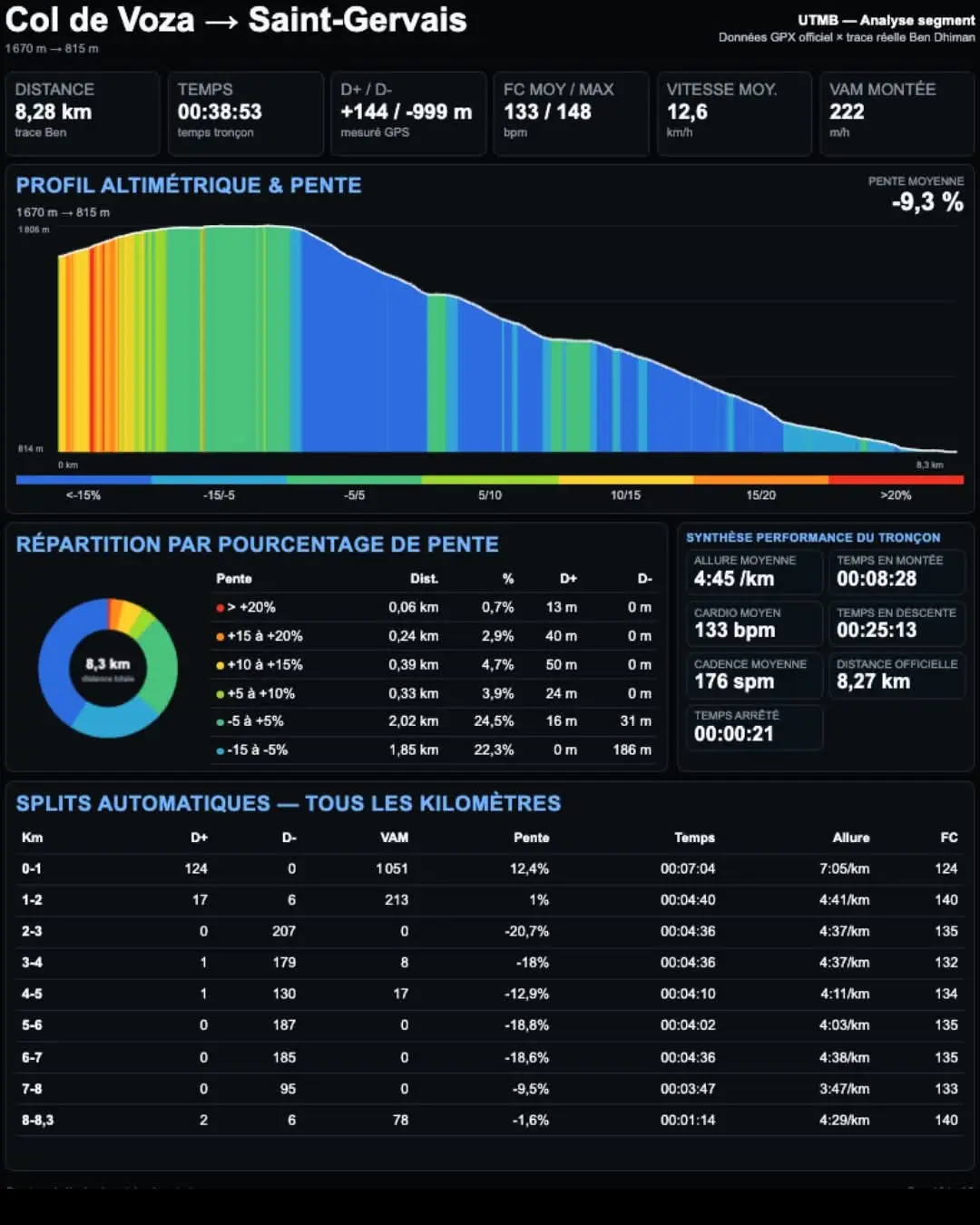
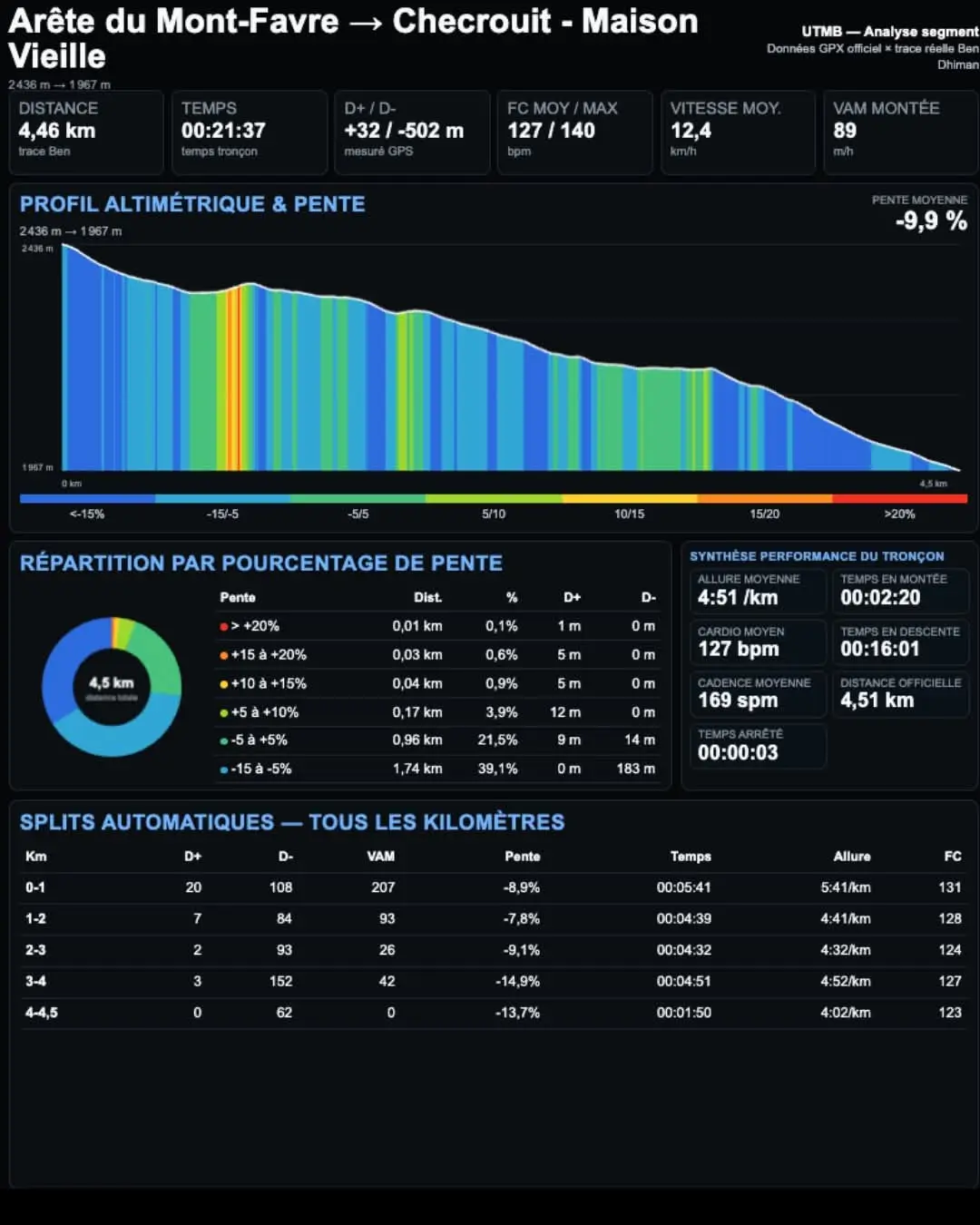
- Col de Voza → Saint-Gervais: 8.28 km, −999 m, 38:53 (≈4:42/km)
- Grand Col Ferret → La Fouly: 9.7 km, −1,025 m, 46:52 (≈4:50/km)
- La Flégère → Chamonix: 6.56 km, −857 m, 33:48 (≈5:09/km)
The final descent was slower — about 10% per kilometre against the early Col de Voza descent. That’s real fatigue, plain and simple. What changes its meaning is the context: seventeen hours of racing, more than 160 km of load, repeated major climbs and descents, and a recent fall. Dhiman was also half an hour clear, while Olson was chasing Chassagne for second and missed him by 46 seconds. Their incentives on that hill were not the same.
He clearly didn’t descend as fast at the end as he had at the start. What stands out is that the drop-off stayed contained rather than spiralling.
His cadence across the three went 176, 171, 167 spm. That doesn’t prove his running economy held up: turnover can stay steady even as stride length, ground contact and force production quietly decline. All it tells us is that turnover itself never collapsed, and that’s as far as the number can take us.
What about his heart rate?
The heart-rate data is considerably harder to interpret.
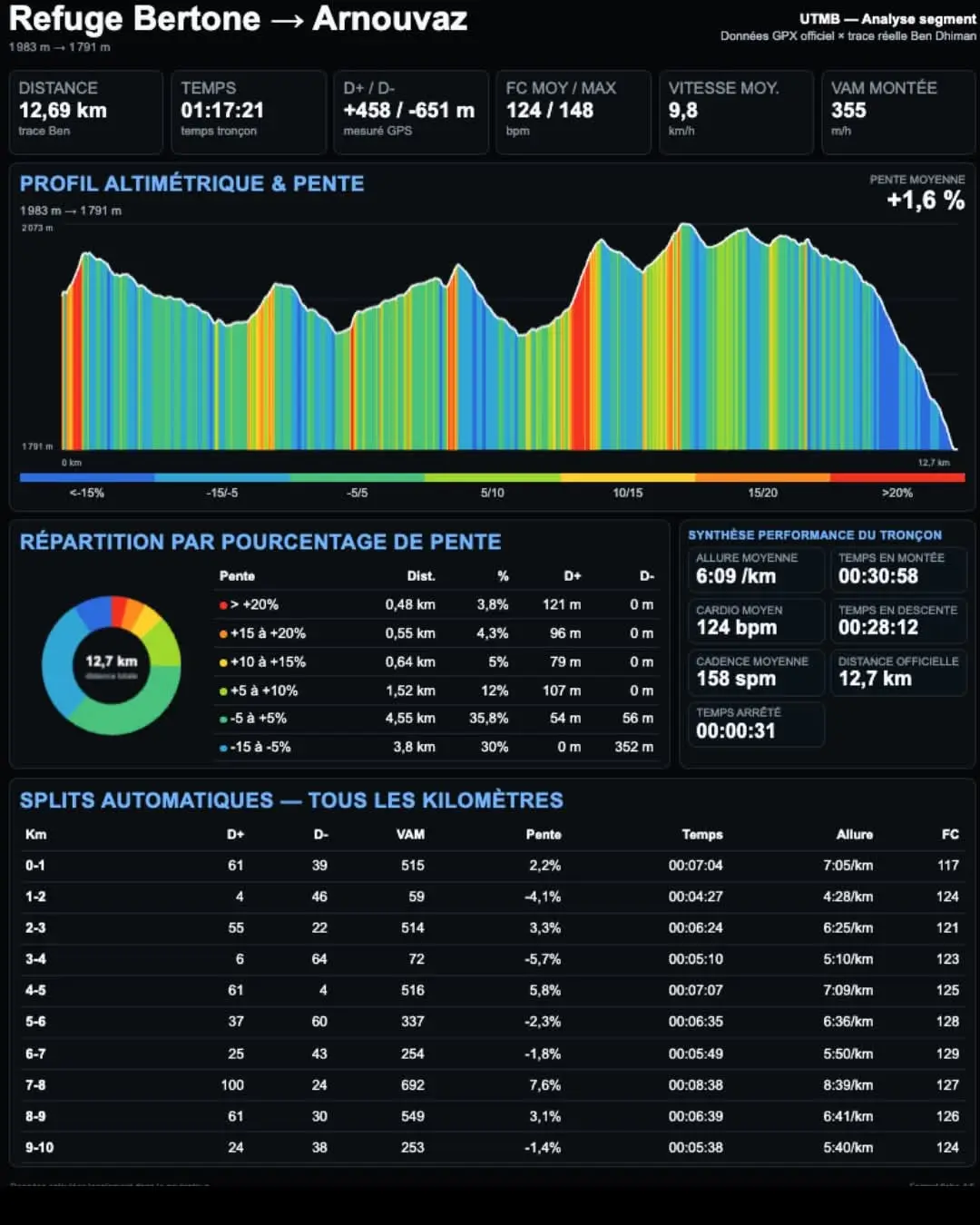
Segment averages range from 112 to 146 bpm. The highest came on more runnable ground — 146 from Saint-Gervais to Les Contamines, 143 from La Balme to Les Chapieux — while two of the steepest climbs read lower, at 119 to Bertone and 128 to Grand Col Ferret. The final descent reads 112.
It is tempting to call that extraordinary pacing control. I would not. Cold conditions, pole use, wrist movement and changes in sensor contact can all make wrist optical heart-rate data less reliable, and several were present here. The movement trace is much stronger evidence than the heart-rate trace.
What the data can and cannot support
The trace is useful. It is not laboratory data, and its own headline numbers do not fully reconcile.
The reported 169.38 km over 18:14:01 works out closer to 6:28/km than the 6:29 displayed. The 19 segment times do not sum exactly to the total. And the trace’s 169.38 km and +9,843 m sit against UTMB’s official 174 km and 9,700 m.
Its gradient figures are not elevation gain divided by distance either: 802 m over 5.28 km is about 15% net, while the platform reports 18.1%. That may reflect ascending-only portions, point-by-point sampling, or something else — the method is not published, so those percentages are reported gradients rather than survey measurements. The same caution applies to the distribution table above.
One recorded kilometre shows 352 m of ascent in 18:56. If both inputs are right, the resulting 1,116 m/h follows arithmetically; the uncertainty is whether GPS distance and elevation are precise enough on that terrain to trust either input.
The 18:46 it classifies as stopped time is similarly narrow. It means the algorithm rarely registered him as stationary — not that he spent only 18 minutes servicing himself, since a runner can walk an aid station, refill on the move or eat slowly without ever being counted as stopped.
None of this makes the dataset useless — it just sets the boundary of what it can answer. The trace works well for comparing Dhiman against himself: early versus late, climbing versus descending, steep versus runnable. It’s the wrong tool for pinning down any single metre, second or percentage as exact.
What he says he built
Everything above is measurement. This section comes from Dhiman’s own description of his preparation, so it is a different kind of evidence.
The interesting part is how closely his stated training problem matches what appears in the race.
His diagnosis came from 2025. Dhiman finished second at UTMB in 19:51:37, but later described himself as having “blown up in the final third.” For 2026, the quality he said he wanted to improve was durability: the ability to keep performing once deep fatigue had accumulated.
His answer was a large increase in training volume without a similar increase in intensity.
For six straight weeks before UTMB, he said he averaged roughly 25 hours, 200 km and more than 10,000 m of climbing per week. July alone passed 100 hours of training, versus less than 60 in the same period the year before. He said he deliberately controlled intensity so that he could absorb the larger load.
The volume had been building much earlier. During the winter, Dhiman reported 305 hours and 170,000 m of vertical gain across three months, much of it through ski mountaineering.
He also changed how he trained climbing.
Dhiman said his climbing volume was around 30% higher than in 2025. More importantly, he did much more steep hiking, often with poles and his UTMB kit. He explained that the year before he had treated UTMB too much like a running race and avoided hiking. In 2026, he trained hiking deliberately because so much of UTMB’s climbing would be hiked anyway.
His racing fitted the same approach.
At the 90K du Mont-Blanc, he finished second in 9:38:02. He later described the race as preparation rather than an event where he intended to perform at his maximum, fitting the same high-volume approach.
One of his final hard sessions before UTMB was even more specific: 75.17 km from Chamonix toward Courmayeur, +4,519 m, in 8:18:14. It was another long day on race terrain before tapering.
None of that proves that a particular training method produced a particular UTMB split.
But the match is hard to miss.
He said the weakness was the final third. He trained specifically to remain effective under accumulated fatigue. And in 2026, the most interesting part of his race is exactly what happened after 100 km, then after 150 km: the lead survived, the movement modes remained available, and when Chassagne briefly reduced the gap, Dhiman opened it again.
Why this performance deserves admiration
Dhiman did not maintain one pace for eighteen hours. That was never possible on this course. He moved from 4:17/km on runnable ground to more than 11 minutes per kilometre on steep climbing, from cadence in the 170s into the 120s and back again, and his final major descent was slower than his first.
He fatigued, as any runner would over that distance and terrain. The important part is what remained available despite that fatigue. He could still run when the trail opened, switch to hiking when the grade demanded it, descend after a long climb, and then return to running again.
That pattern was still visible after 100 km and after 150 km. When Chassagne reduced the lead between Champex-Lac and Trient, Dhiman still had enough to open it again before Vallorcine.
That matches the problem he said he had tried to solve after 2025. He described himself as having “blown up in the final third,” then built his 2026 preparation around durability, more climbing and much more hiking-specific work.
He fell late in the race, got back up, completed the remaining mountain section and descended into Chamonix. Second place arrived 31 minutes and 9 seconds later.
His 2026 time was 1:35:08 faster than his own 2025 UTMB. That comparison is not perfectly controlled: weather and route details differed. But both races bypassed Pyramides Calcaires, and the scale of the improvement is still striking.
18:16 is the final number. The more interesting story is what was still working when the final third arrived.

